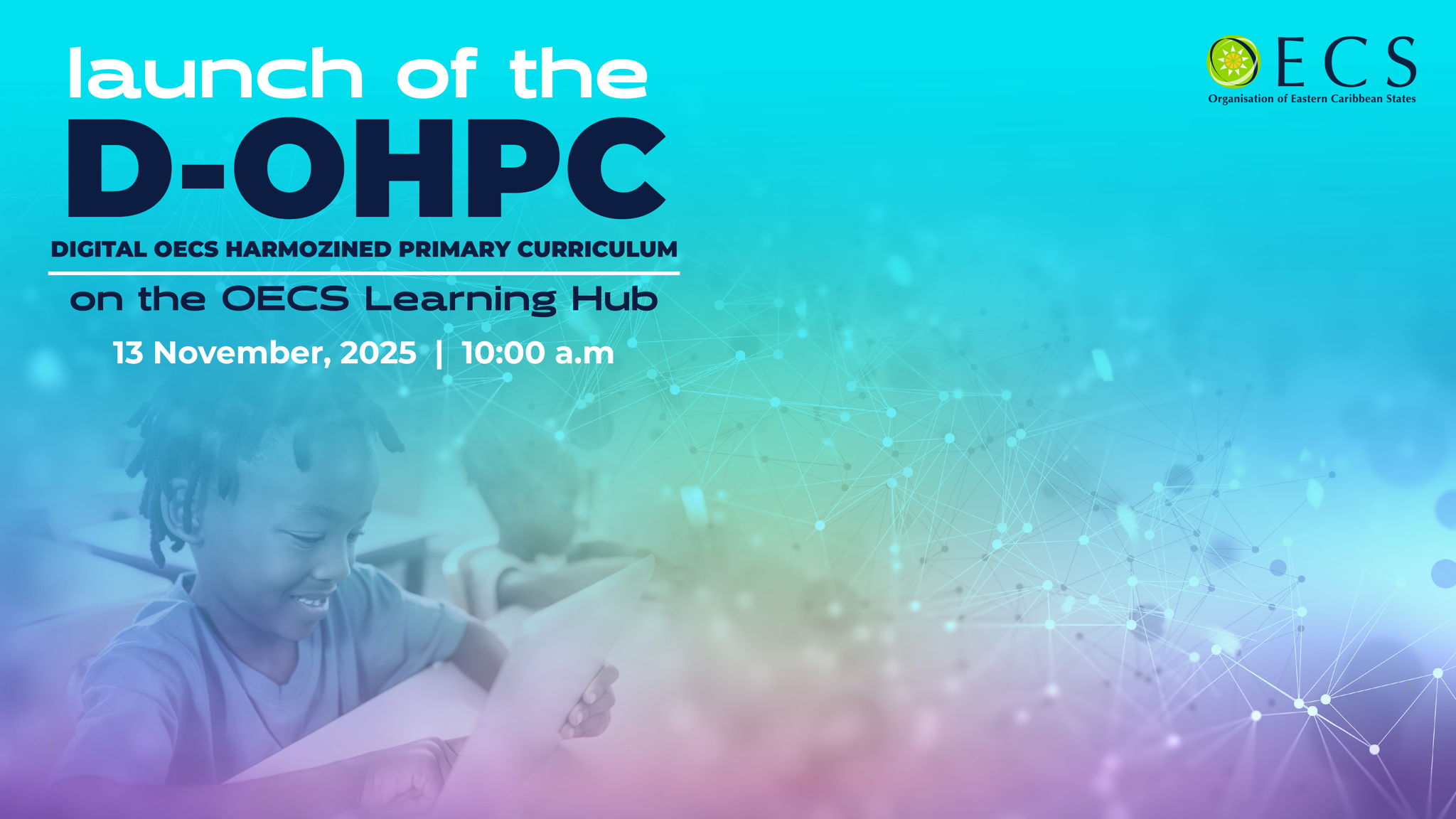
OECS Launches Digital Harmonised Primary Curriculum on November 13 — A Regional Celebration of Learning and Progress
OECS MEDIA RELEASE
The Organisation of Eastern Caribbean States (OECS) officially unveiled the Digital Harmonised Primary Curriculum (D-OHPC) on Wednesday, November 13, at 10:00 a.m. AST. Citizens across the region and diaspora were invited to participate in this landmark moment for education. The launch was hosted in a blended format, with opportunities for in-person participation in designated public spaces and virtual access via OECS Commission and Ministry of Education media platforms.
The D-OHPC represents a strategic investment in the children of the OECS, their present learning and future potential. Developed under the OECS Programme for Educational Advancement and Relevant Learning (OECS PEARL), which is funded by the Global Partnership for Education (GPE), the curriculum is designed to strengthen foundational skills, promote equity, build resilience, and equip students with the tools to navigate an increasingly complex global landscape.
Over 150 educators from across the region contributed to the development of this new curriculum, including teacher educators, curriculum and assessment officers, principals, and classroom teachers. Their diverse expertise, which ranges from early childhood and special education to technical and vocational fields as well as the creative arts, has shaped a curriculum that is both academically robust and culturally grounded.
The platform housing the curriculum, the OECS Learning Hub, is powered by technology and enhanced by artificial intelligence, thanks to the OECS Software Development Team, a group of innovative young professionals who have created an intuitive, immersive experience for educators and learners. The curriculum also enables cross-border resource sharing, allowing teachers across Member States to access materials that reflect the heritage, geography, and social context of OECS countries.
To support implementation, the OECS PEARL introduced MyPD, a professional development programme that equips educators with the skills and confidence to engage with the curriculum meaningfully. The programme also includes the OECS Early Reading and Early Mathematics Assessments, designed to monitor learning outcomes at the Grade 2 level across schools, countries, and students. These tools will provide valuable data to inform policy decisions and improve classroom practice.
Delivering remarks at the launch, Dr. Didacus Jules, Director General of the OECS, emphasised the importance of the initiative. He stated:
“This launch represents far more than the digitisation of a curriculum; it symbolises a decisive leap forward in shaping our own educational destiny. It is a product of OECS ingenuity, crafted by our teachers, our curriculum officers, our technologists and our visionaries who understand the rhythm of our classrooms, the heartbeat of our children, and the aspirations of our communities. What we celebrate today is a triumph of local capacity and creativity.”
Mrs. Sisera Simon, Head, Human and Social Division, OECS Commission, highlighted the significance of the achievement and the collaboration involved. She remarked:
“Today, we celebrate the launch of the OECS Digital Harmonised Primary Curriculum, a landmark achievement shaped by the hands and hearts of more than one hundred and fifty educators across our region. Teacher educators, curriculum specialists, assessment officers, principals and classroom teachers worked collaboratively, bringing expertise from early childhood, special education, technical and vocational fields and the creative arts.”
Mr. Rafer Gordon, Project Manager for the OECS PEARL echoed their sentiments about the momentous occasion. He stated:
“[The D-OHPC] is a major regional achievement and an outstanding milestone. It brings together the best of the OECS, its educators, its cultures, and its technologies to create something that truly regenerates OECS education systems.”
The OECS invites all citizens, parents, educators, students, and community members to view the launch on the OECS’ YouTube page and be part of this historic moment. To learn more, visit the OECS Learning Hub at https://oecslearninghub.org/.

Media contact
Malika Thompson-Cenac
OECS Communications Unit