OECS SKIP Validates Regional Strategic Framework for Post-Secondary Education
OECS Media Release
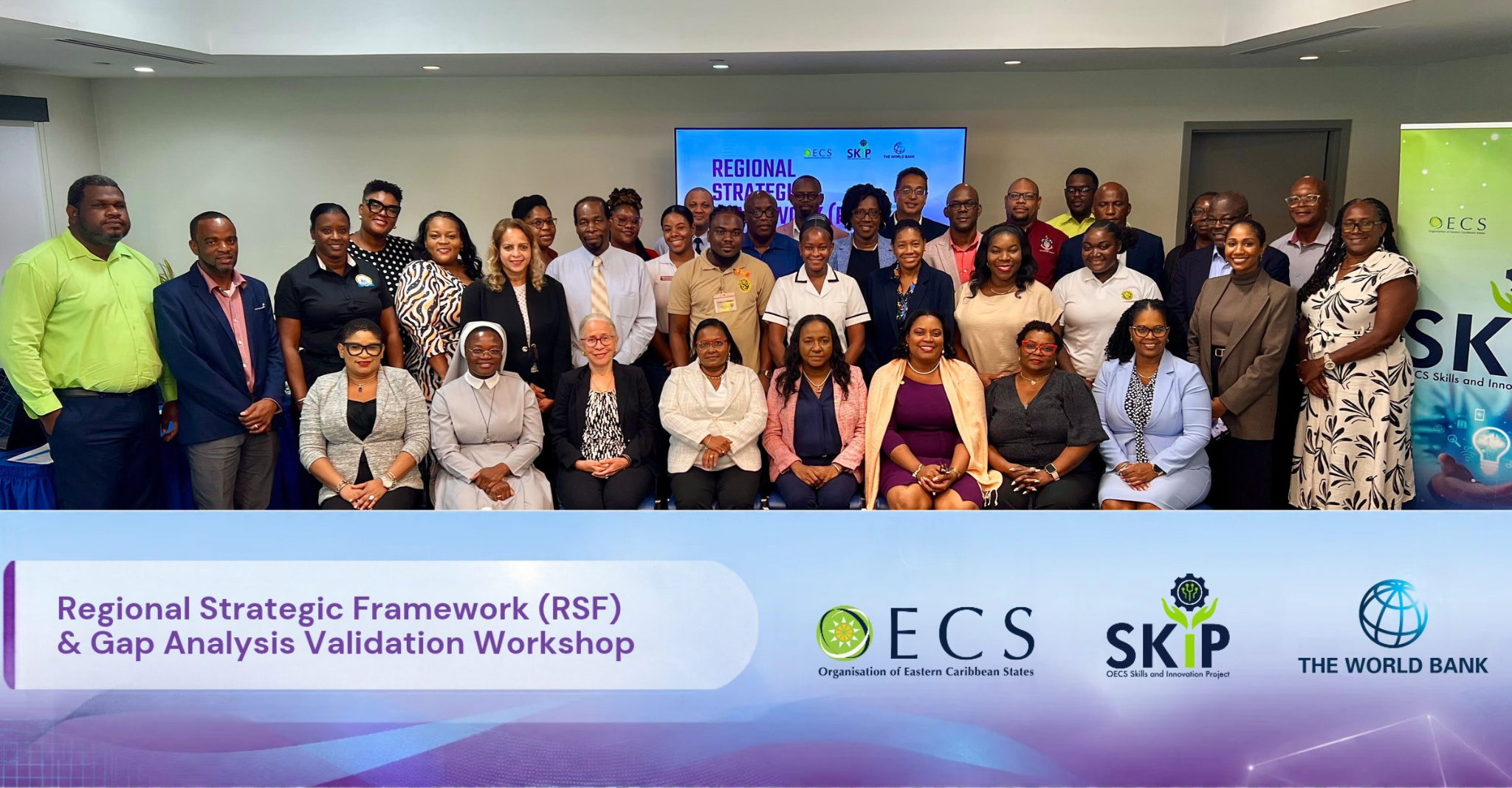
The Organisation of Eastern Caribbean States (OECS) Skills and Innovation Project (SKIP) recently finalised a major push to transform post-secondary education in the OECS region, culminating in the Regional Strategic Framework (RSF) and Gap Analysis Validation Workshop. Held from October 28th-29th, 2026, the landmark event brought together a diverse coalition of key regional post-secondary education leaders, accreditation officials, private sector partners, regional disaster management agencies, technical experts and student leaders to build consensus and formally approve a connected, climate-resilient framework for post-secondary education.
Serving as a pivotal collaborative endeavour, the workshop successfully secured regional validation for two foundational deliverables under Component 1 of the OECS SKIP:
- The Revised Assessment Report on the Post-Secondary Sector (Comprehensive Gap Analysis).
- The Regional Strategic Framework (RSF) for Post-Secondary Education, along with its accompanying 10-Year Operational Plan, Sub-Operational Plans, and Monitoring & Evaluation (M&E) Framework.
This milestone directly advances the World Bank-funded OECS SKIP's objectives to strengthen and coordinate post-secondary education across Member States through regional collaboration, quality assurance, innovation, workforce alignment, and equitable access under the vision "Every Learner Succeeds." Delivering remarks at the opening ceremony, Mrs Sisera Simon, Director, Human and Social Division, OECS Commission, highlighted the regional significance of the initiative, stating:
"For the OECS Commission, addressing the journey of learners is not merely an administrative priority, it is the heartbeat of regional integration. While individual island nations grapple with limited resources, a unified pathway forward creates opportunities no single country could offer on its own. We are here over the next two days to validate three crucial foundational pillars: a comprehensive analysis serving as our honest mirror, a regional strategic framework where collaboration yields the greatest impact, and an operational plan outlining the precise roadmap for our future."
The post-secondary sector assessment delivers a rigorous, empirical evaluation across OECS Member States, mapping current institutional landscapes, governance models, accreditation frameworks, and cost barriers. Rather than operating in isolation, OECS Member States are co-creating a unified 10-year Regional Operation Plan to eliminate duplication and maximise shared regional resources.
Key outcomes and strategic value of the new framework include:
- Regional Centres of Excellence: Specialised institutional hubs sharing technical expertise and resources across island borders.
- Employer-Driven Curriculum: Direct alignment of Technical and Vocational Education and Training (TVET) and tertiary training with high-demand regional sectors, including technology, innovation, climate resilience, and skilled trades.
- Seamless Mobility: Standardised qualifications, such as the Caribbean Vocational Qualification (CVQ), enabling students and workers to move seamlessly across Member States.
- An Integrated Digital Ecosystem: A unified learning infrastructure featuring a shared Virtual Campus, Knowledge, Technology and Innovation Platform (KTIP), and an advanced regional Education Management Information System (EMIS).
Echoing this collaborative vision during the workshop, Ms Francillia Solomon, OECS SKIP Project Manager, OECS Commission, emphasised the hands-on nature of the regional effort:
"We are here to 'work' on the proposed reports, through your respective experiences and lenses, To review and help shape the validated results so that they will be easier to implement in the short to medium term, as we chart the future direction of post-secondary education across the OECS."
Following the workshop's conclusion, the generated technical feedback, agreed revisions, and key recommendations were collated into a Master Validation Matrix. This comprehensive matrix has been submitted directly to the Regional Project Steering Committee (RPSC) to finalise the project-level validation and drive the immediate regional implementation roadmap.


