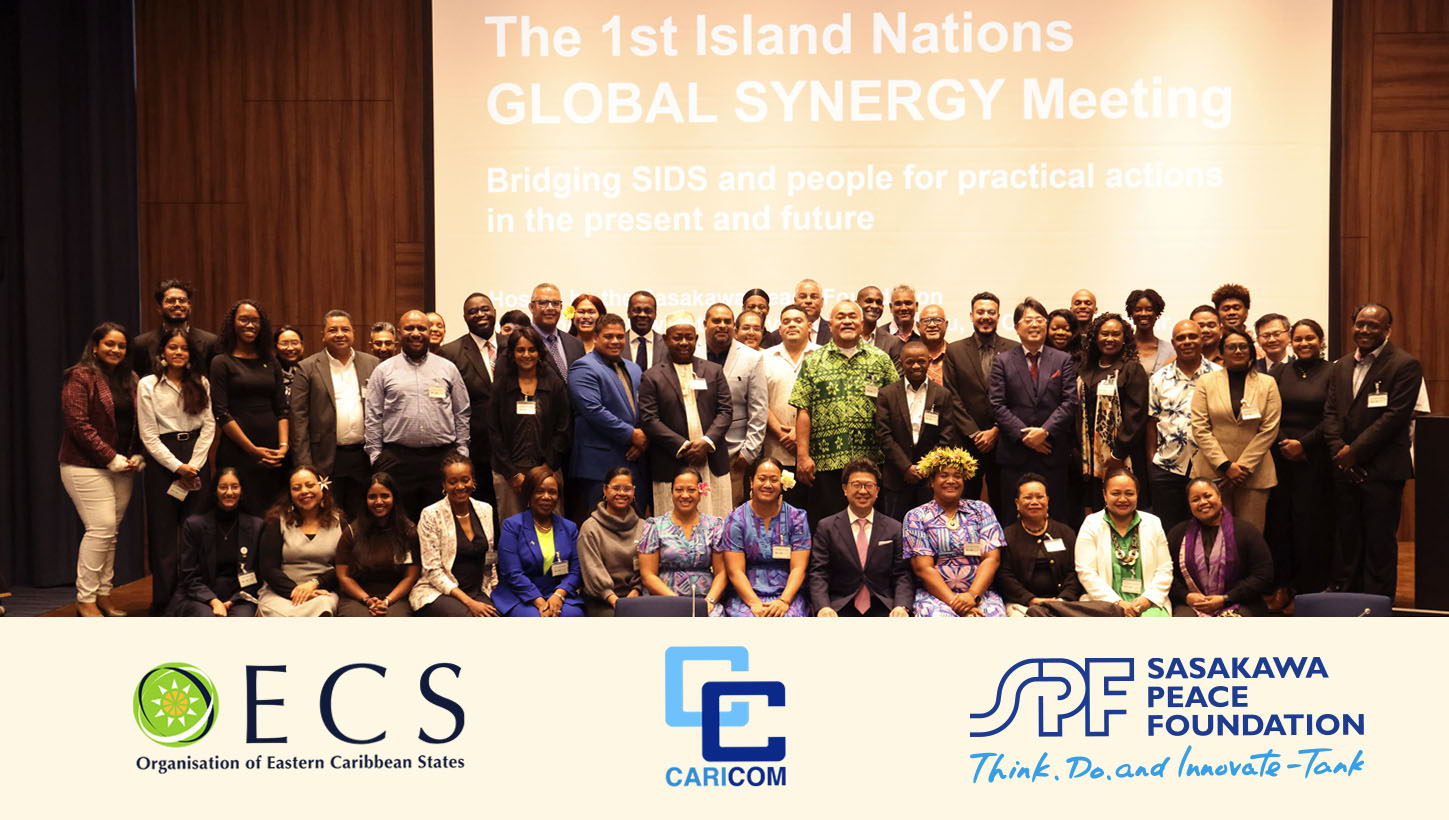
OECS Participates in Island Nations Global Synergy Meeting in Tokyo
OECS Media Release
The Organisation of Eastern Caribbean States (OECS) Commission joined global partners at the Island Nations Global Synergy Meeting 2026, hosted by the Sasakawa Peace Foundation (SPF) in Tokyo, Japan, on March 12–13, in an effort to advance dialogue and action on sustainable development and resilience across Small Island Developing States (SIDS).
Held under the theme “Bridging SIDS and people for practical actions in the present and future,” the meeting built on outcomes from regional dialogues hosted over the past year in Saint Lucia, Palau, and Mauritius. It brought together practitioners from the Caribbean, Pacific, and Western Indian Ocean regions to deepen collaboration, strengthen human networks, and accelerate the transition from policy commitments to real-world impact.
Participants highlighted the shared vulnerability of SIDS to climate change, including rising sea levels, coastal erosion, coral reef degradation, and increasingly intense weather events. These environmental pressures continue to threaten livelihoods, food security, and the cultural identity of island communities, while also posing broader developmental and existential challenges.
The meeting further underscored systemic barriers faced by SIDS, including difficulty accessing climate finance, limited institutional and technical capacity, slow disbursement of international funding, and gaps in specialised expertise. Despite these constraints, participants emphasised the blue economy's critical role in driving resilience, economic opportunity, and sustainable development.


A central focus of the meeting was identifying practical pathways to move from dialogue to action. Discussions highlighted the importance of scaling community-led solutions; strengthening knowledge-sharing mechanisms through platforms and peer-to-peer exchanges; expanding access to financing for resilience and blue economy initiatives; empowering youth leadership and innovation; and reinforcing regional and global collaboration among SIDS.
“This Global Synergy Meeting represents a critical shift from dialogue to delivery. For Small Island Developing States, we must move beyond commitments to practical, people-centred solutions that strengthen resilience and unlock sustainable development opportunities,” said Nadege Jn Baptiste, Head of the Development Cooperation and Resource Mobilisation Unit at the OECS Commission.
Several examples of successful local initiatives to build sustainable futures were shared, including mangrove restoration, conservation networks, and traditional ecosystem management practices, reinforcing the importance of locally driven, context-specific solutions.
Interactive sessions explored mechanisms to improve collaboration among SIDS regions and to overcome longstanding barriers to engagement. Participants expressed appreciation for the in-person exchanges among technical professionals, the development of practitioner networks, and the need for stronger coordination mechanisms to sustain collaboration beyond global forums.
The meeting also strengthened ties with Japanese stakeholders, including the Japan International Cooperation Agency (JICA), recognising opportunities to expand cooperation in sustainable development, capacity building, and climate resilience.
A recurring theme throughout the meeting was the importance of integrating traditional knowledge with modern scientific approaches to develop tailored, effective solutions. It was noted that combining these knowledge systems is essential for strengthening adaptation strategies, protecting ecosystems, and ensuring sustainable development outcomes across SIDS.
At the end of the meeting, there was a call for meaningful reforms in global financing systems to better support SIDS, particularly in improving access to funding and accelerating disbursement processes. The need for clearer financing pathways for community-level initiatives and stronger alignment between global funding mechanisms and local priorities was also highlighted.
The OECS Commission, through its Development Cooperation and Resource Mobilisation Unit, played a key role in coordinating regional engagement and facilitating dialogue among Caribbean stakeholders. The Commission was entrusted to spearhead Caribbean coordination within this global initiative, reinforcing its leadership in advancing sustainable development and climate resilience across the region.
The Global Synergy Meeting is expected to serve as an ongoing platform for collaboration among governments, civil society organisations, academic institutions, and development partners. While not a formal negotiating forum, it is designed to catalyse technical cooperation projects, partnerships, and actionable solutions across SIDS. Upcoming high-level engagements later this year are expected to strengthen commitments further and expand opportunities for collaboration with Japanese partners and other stakeholders.


About the Sasakawa Peace Foundation (SPF)
The Sasakawa Peace Foundation (SPF) is a Japanese private, non-profit foundation established in 1986 to promote international cooperation, peacebuilding, and sustainable development. It operates as both a think tank and an action-oriented organisation, conducting research, supporting policy dialogue, and implementing practical projects worldwide to address complex global challenges such as security, climate change, and social development. Through partnerships with governments, institutions, and communities, SPF works to strengthen international exchange, foster innovation, and contribute to a more peaceful and inclusive global society.
Danny Moonie
OECS Communications Unit