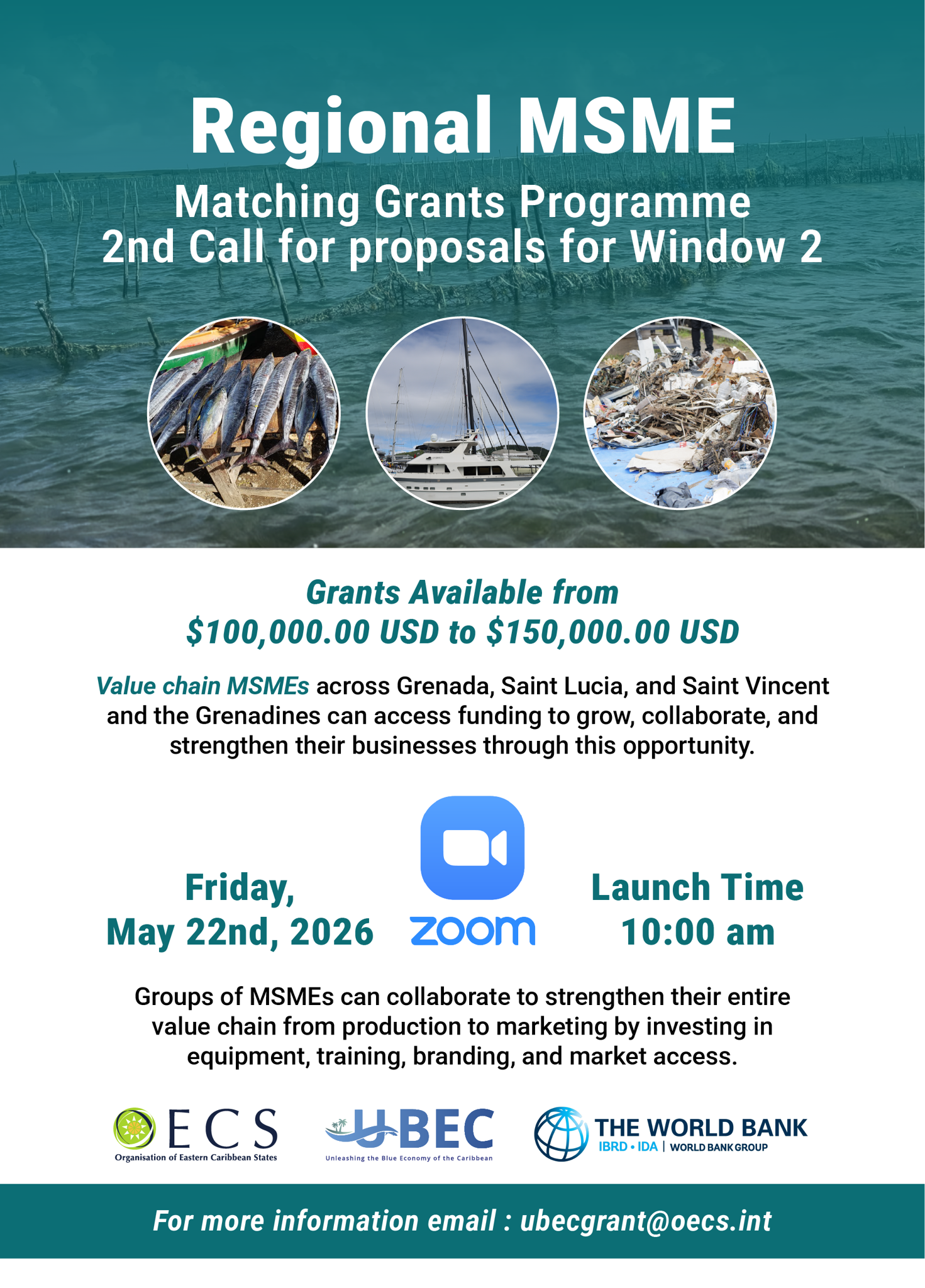
OECS Launches Second Call for Proposals for Value Chain Groups Under Regional MSME Matching Grants Programme
Blue Economy entrepreneurs across Grenada, Saint Lucia, and Saint Vincent and the Grenadines are being urged to seize a major opportunity to scale their businesses through collaboration, as the Organisation of Eastern Caribbean States (OECS) Commission prepares to launch the Second Call for Proposals for Window 2 of the Regional MSME Matching Grants Programme (MGP).
The virtual launch will take place on Friday, May 22, 2026, from 10:00 am to 12:00 pm via webinar.
Webinar Link: https://bit.ly/4tgHnIP
This second call specifically targets Value Chain Groups operating within the fisheries, marine tourism, and waste management sectors, offering grant funding ranging from USD $100,000 to USD $150,000. These grants are designed to support groups of interconnected businesses working collaboratively to strengthen production, improve efficiency, and increase market competitiveness across the Blue Economy.
The initiative forms part of the Unleashing the Blue Economy of the Caribbean (UBEC) project, implemented by the OECS Commission with funding from the World Bank. For more information, visit: https://www.oecs.int/en/unleashing-the-blue-economy
Strengthening Businesses Through Collaboration
Unlike individual grants, Window 2 focuses on the power of partnerships. Value Chain Groups comprised of at least three MSMEs are encouraged to align their operations, from production to processing to distribution, to unlock greater value collectively than they could individually.
A Value Chain Group refers to a network of businesses that operates at different stages of producing, enhancing, and delivering a product or service to the market. For example, in the fisheries sector, this could include fishers, processors, distributors, and retailers working together; in marine tourism, tour operators, service providers, and hospitality businesses; and in waste management, collectors, recyclers, and manufacturers using recycled materials. By linking these stages, Value Chain Groups create a more efficient, coordinated system that reduces gaps, improves quality, and increases overall profitability.
In the Eastern Caribbean, where resources and markets can be limited, collaboration is a strategic advantage. By working together, MSMEs can:
- Improve product quality and consistency
- Reduce operational costs through shared resources
- Access larger markets and new export opportunities
- Build resilience against economic and environmental shocks
This approach is expected to significantly elevate the competitiveness and sustainability of the region’s Blue Economy.
Eligibility Criteria
To qualify, Value Chain Groups must meet the following requirements:
- Be comprised of at least three legally registered MSMEs
- Operate within Grenada, Saint Lucia, or Saint Vincent and the Grenadines
- Function within the fisheries, marine tourism, or waste management sectors
- Demonstrate an existing or potential value chain relationship (e.g., supplier, processor, distributor)
- Each participating MSME must:
- Be operational for at least two years
- Provide financial statements or bank records for the past two years
- Maintain a business bank account
- Employ no more than 50 persons
- Generate annual revenues not exceeding USD $1,000,000
Real Impact: From Individual Success to Collective Growth
The success of the first call for proposals under Window 1 has already demonstrated the transformative impact of these grants on individual MSMEs.
Grenadian entrepreneur Tamara Prosper, owner of Tambran by Tamara, an eco-jewelry brand that transforms recyclable and natural materials into luxury accessories, shared how the funding elevated her business,
“With the UBEC funds, we took a very holistic approach. We focused on machines that would scale our business and would improve efficiency. We used the funds specifically for bottle neck cutters so our processes would be standard. We also used it for packaging purposes as well as marketing and general outfitting our hair hive product. Important to note is that we used some of the funds to do the application for a utility patent for our hair hive accessories.”

Securing intellectual property rights, such as a utility patent, is a critical step for MSMEs. It protects innovation, prevents imitation, and creates opportunities for long-term revenue generation through licensing or exclusive market positioning, key elements for sustainable business growth.
Similarly, Saint Lucian fisherman John Magloire highlighted the direct impact of the grant on his operations. The grant allowed him to purchase an engine for his fishing vessel.
With over 25 years of experience at sea, including 19 years as a captain, Magloire has also used his expertise to uplift others:
“I have two students. I bring them out to sea and I trained them and now they are captains.”

These stories underscore how individual MSMEs have already been strengthened. Now, the focus shifts to transforming entire value chains, enabling groups of businesses to grow together and multiply their impact across the region.
Inclusive Opportunity for Growth
The OECS Commission encourages all eligible MSMEs, men and women alike,to apply, while continuing to support the strong participation of women-led and women-managed enterprises across the Blue Economy. Diversity in participation strengthens innovation, resilience, and long-term sector growth.
A Call to Action
Eligible Value Chain Groups are strongly encouraged to attend the virtual launch and begin preparing their applications. This is a unique opportunity to access substantial funding, build strategic partnerships, and position businesses for sustainable growth within the Blue Economy.
By working together, MSMEs can move beyond survival to shared success,creating stronger industries, more resilient communities, and a more competitive Eastern Caribbean Blue Economy.
For additional information or assistance, interested applicants can contact the team via email at mgp.unit@oecs.int.
Jacques Hinkson-Compton
OECS Communications Unit