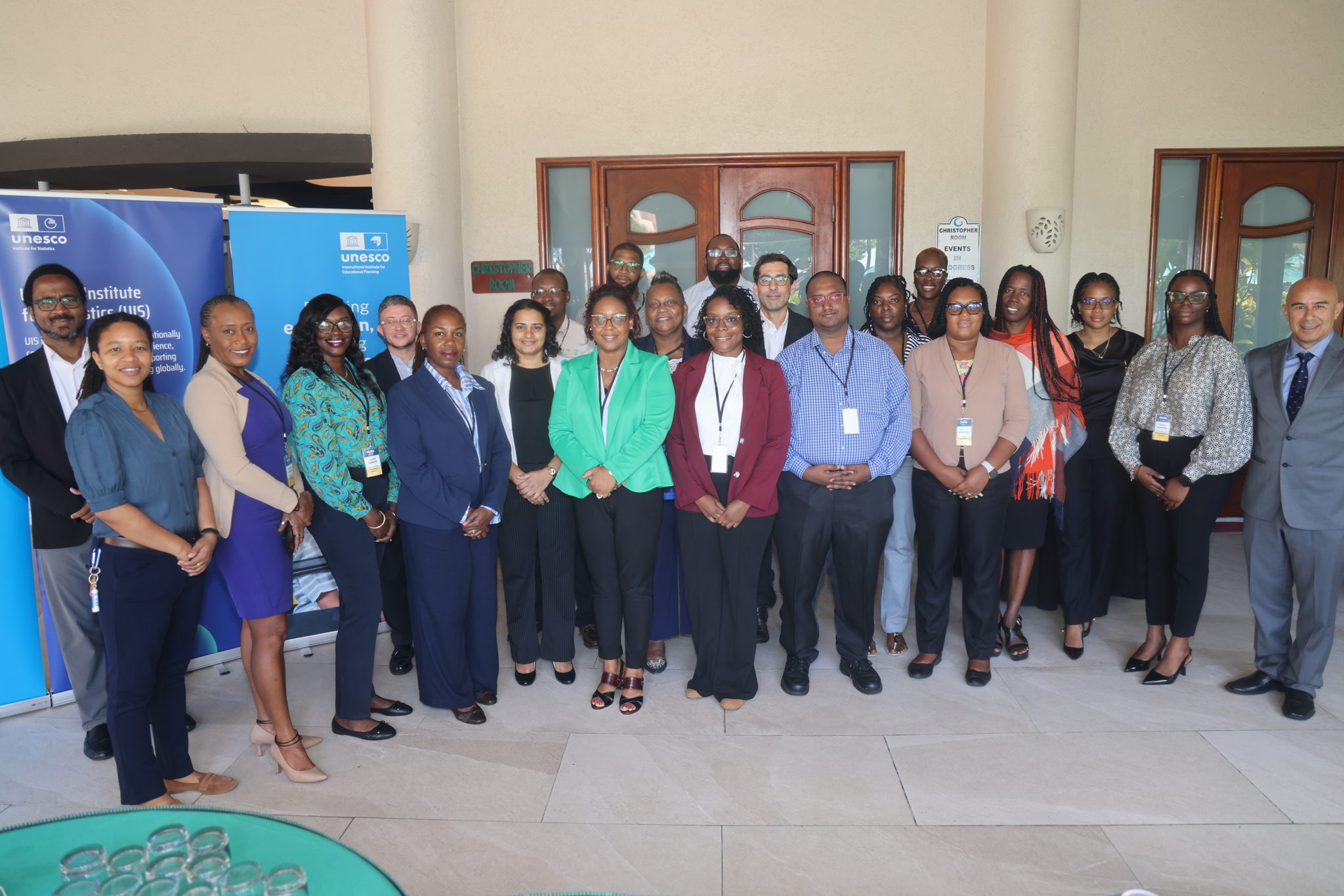
OECS Launches Regional Programme to Strengthen Education Data, with IIEP, UIS and UNICEF
OECS Media Release
Education planners, statisticians, and junior statistical officers from nine OECS Member States concluded a two-day intensive workshop at the Accra Beach Hotel and Spa in Barbados on November 18, marking a major milestone in strengthening regional education systems. Held under a new regional programme to strengthen Ministries of Education's ability to produce and use data for decision-making, the OECS Regional Education Data Capacity Development Workshop was delivered by the Organisation of Eastern Caribbean States (OECS) Commission in partnership with the UNESCO International Institute for Educational Planning (IIEP-UNESCO), the UNESCO Institute for Statistics (UIS), and the United Nations Children's Fund (UNICEF) as part of a two-month hybrid programme running from October to December 2026.
This programme marks a shift from annual meetings used for more than a decade to compile the Regional Education Statistical Digest, to sustained national capacity that complements the new Regional Digest platform. It responds to needs identified by Ministries of Education across the OECS region during consultations in April and May 2026, which include stronger technical skills, broader staffing of data functions, and stronger policies and platforms.
Opening the workshop, Mr Germain Anthony, Senior Technical Specialist for Education at the OECS Commission, linked the training to the final evaluation of the OECS Education Sector Strategy (OESS) and the preparation of a refreshed strategy. “You are the custodians of the evidence on which the next strategy will rest,” he told participants.
Partners echoed this message. “We cannot report data to OECS without good national data. We cannot report data to UIS without good national data,” said Mr Am Gagnon, Senior Programme Specialist at IIEP-UNESCO. Mr Manuel Alcaíno, Regional Advisor for Latin America and the Caribbean at UIS, urged participants to “go beyond administrative data,” while Mr Lyston Skerritt of UNICEF encouraged participants to reflect by asking, “What is the value of your work to the children?”
Over the two days, participants mapped their national data systems, assessed data quality, measured Sustainable Development Goal 4 indicators from their own data, and learned the power of data visualisation techniques to present evidence clearly to decision-makers. They also reviewed the OECS's public platform for regional education statistics, oecsdigest.org. A next phase was proposed at the event for each Member State to soon manage and publish their own national digests, which will then feed aggregated data to the regional digest. Mr Skerritt described this development as “a best practice” that should be shared.
As an immediate next step, the OECS Commission will present the Regional Data Management Framework to Permanent Secretaries and Chief Education Officers at the OECS Education Sector Strategy Implementation Meeting (November 24-27), ahead of the OECS Council of Ministers: Education meeting scheduled for February 2027. Meanwhile, the training programme continues online, with country team assignments and deliverables due on December 7, 2026. Participants who complete the training will receive an IIEP Certificate of Participation.
Participating Member States include Anguilla, Antigua and Barbuda, the British Virgin Islands, Dominica, Grenada, Montserrat, Saint Kitts and Nevis, Saint Lucia, and Saint Vincent and the Grenadines.


Malika Thompson-Cenac
OECS Communications Unit