OECS – Guadeloupe: International Ambition for Guadeloupean Youth
Joint Article - Courtesy of France Antilles Guadeloupe
Regional integration is often perceived as a distant institutional topic. However, driven by the Regional Council of Guadeloupe, the archipelago's membership in the Organisation of Eastern Caribbean States (OECS) since March 14, 2019, is radically transforming the prospects of our youth. This Associate Member status is not merely a diplomatic symbol: it places Guadeloupe at the heart of a regional bloc standing in solidarity against global challenges such as employment, training, and climate resilience.
Founded in 1981, the Organisation of Eastern Caribbean States (OECS) is a regional organisation uniting several islands neighbouring Guadeloupe. Its main members, primarily independent states, stretch from north to south: Saint Kitts and Nevis, Antigua and Barbuda, Montserrat, Dominica, Saint Lucia, Grenada, and Saint Vincent and the Grenadines. Joining these countries are associate territories including Guadeloupe, Anguilla, the British Virgin Islands, Martinique, and, since 2025, Saint Martin.
Expanding Horizons: Territorial Diplomacy in Action
For a long time, the horizon for young Guadeloupeans was structured exclusively around a direct relationship with Hexagonal France. The Regional Council’s strategy is breaking this glass ceiling. By anchoring the territory within the OECS, it serves as a reminder that our local environment is multilingual and rich with economic opportunities.
For a student, a young graduate, or a burgeoning entrepreneur, this membership turns geographical proximity into a lever for international exposure. Since 2022, the presence of a Regional Cooperation Officer directly within the OECS Commission in Saint Lucia has facilitated a direct connection between the youth and the organisation’s member countries.
Mobility, Language, and Influence: Targeted Assets
A major contribution of this integration lies in skills development. For the youth of Guadeloupe, the OECS provides the ideal landscape to master English and adapt to multicultural environments, intercultural fluency being a major competitive advantage in a globalised world.
Regional cooperation also opens doors in sports and culture. The participation of our boxers in OECS championships, and exchanges initiated within the creative industries sector, illustrate a logic of circulation and international visibility for our local talent. Guadeloupe no longer simply endures its environment; it exports its excellence to it.


Concrete and Funded Opportunities
The benefit of the OECS is not limited to political promises. In recent years, numerous projects have been implemented with the OECS on sargassum and the energy transition, notably allowing Guadeloupe to showcase its expertise in these fields.
Guadeloupe's membership has unlocked specific opportunities, such as sending young Guadeloupean entrepreneurs to Silicon Valley to be trained by Draper University, which seeks to support entrepreneurship across the Caribbean.
Furthermore, the organisation offers annual internships and job vacancies, now published in French and accessible to Guadeloupean nationals. The Regional Council actively supports this momentum through various volunteering schemes. The VIES Caraïbes programme, co-funded by INTERREG, has already deployed international solidarity volunteers in strategic sectors: environmental sustainability, social protection, and project engineering.
A Field Mission to Make the Future Clear
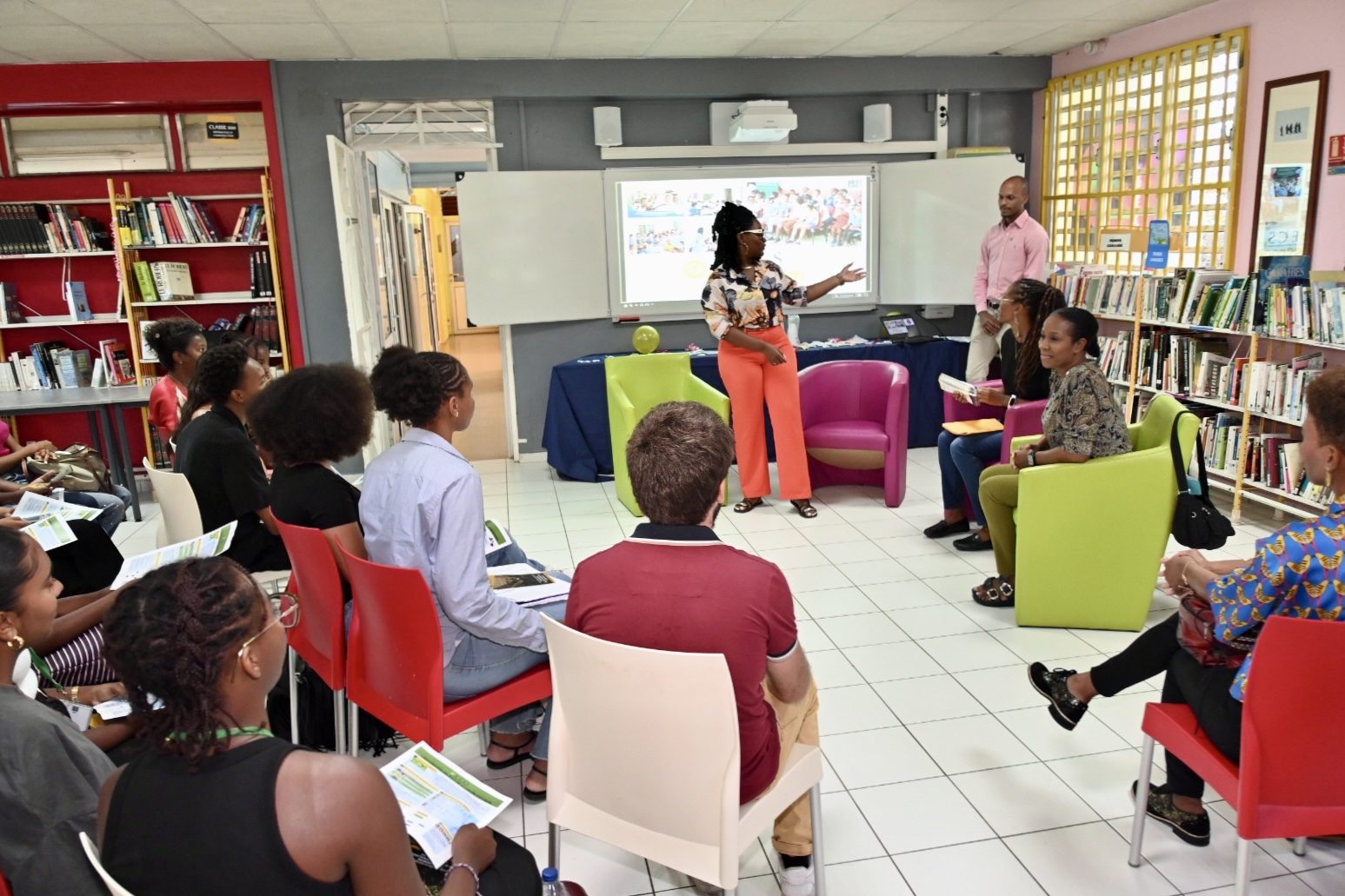
For this membership to bear fruit, it must be widely known. This was the focus of a communication mission conducted in Guadeloupe from March 24 to 28, 2026. An official OECS delegation, accompanied by Regional Council services, visited the Gerville Réache, Jardin d’Essai, and Baimbridge high schools.
The objective was educational: to explain to students that the OECS is a concrete tool for their own career paths. By bringing the institution closer to lived realities, the Regional Council of Guadeloupe reaffirms its commitment to making regional integration a tool for empowerment rather than an abstract concept.
Bringing the Caribbean into the Collective Imagination
OECS membership has paved the way. Structural projects such as Transition Énergie Caraïbe and SARGCOOP already attest to active technical cooperation. However, the ultimate challenge is to integrate the Caribbean into a "future vision" for the youth.
The goal is clear: to make regional cooperation the engine for a self-assured, mobile, and ambitious Guadeloupean youth. It is now up to the Region and its partners to continue making this integration both useful and accessible.


