OECS Commission to Strengthen Commitment to Gender Equality through New Training Series
OECS Press Release
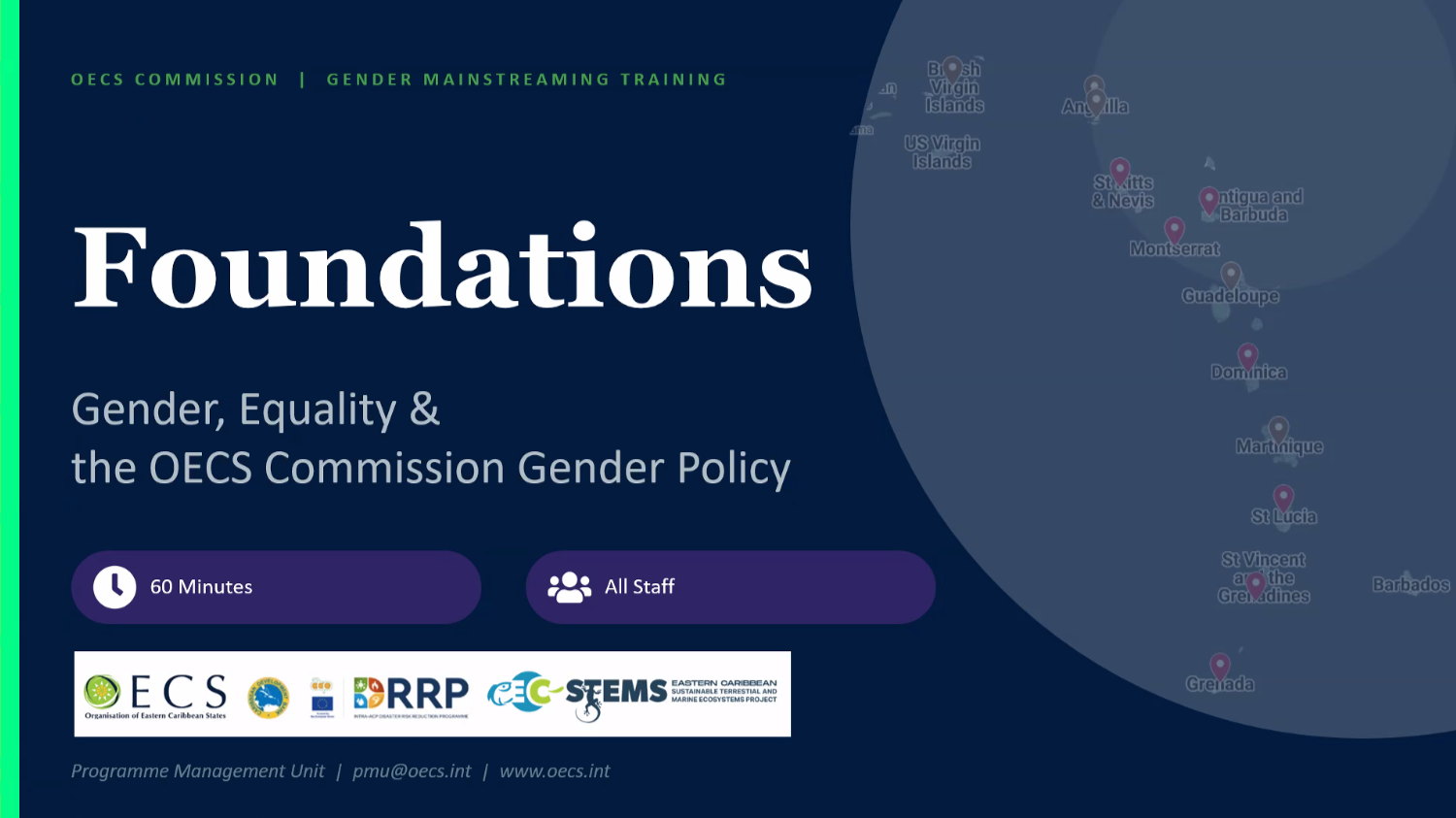
The Organisation of Eastern Caribbean States (OECS) Commission launched a three-part Gender Mainstreaming Staff Training Series on June 15, 2026, reinforcing its commitment to integrating gender equality across all areas of work. The initiative will equip Commission staff with the knowledge, analytical tools, and practical skills needed to apply a gender-responsive approach to the design, implementation, and evaluation of programmes and policies.
Aligned with the OECS Commission Gender Policy (2022), the training will incorporate interactive case studies, practical exercises, and a Gender Marker scoring simulation. This represents a significant step toward strengthening institutional capacity and embedding gender considerations throughout the Commission’s regional development agenda.
The training series also forms part of the broader gender mainstreaming mandate of the Eastern Caribbean Sustainable Terrestrial and Marine Ecosystems (EC-STEMS) Project. The project is implemented by the OECS Commission and funded by the Caribbean Development Bank (CDB) through the Caribbean Action for Resilience Enhancement (CARE) Programme. The CARE Programme is financed by the European Union (EU) under the 11th European Development Fund (EDF) African, Caribbean and Pacific (ACP)–EU Natural Disaster Risk Reduction Programme.
The project supports sustainable land management, community livelihoods, and marine ecosystem restoration across six beneficiary Member States: Antigua and Barbuda, the Commonwealth of Dominica, Grenada, Saint Kitts and Nevis, Saint Lucia, and Saint Vincent and the Grenadines.
The series will be delivered monthly from June to August 2026. They will consist of three interactive sessions covering the Foundations of Gender Equality and the OECS Commission's Gender Policy, Gender Analysis in Practice, and Gender Mainstreaming and Accountability.
Highlighting the importance of the initiative, EC-STEMS Project Coordinator Leshan Monrose stated:
"Gender equality is not a standalone objective. It is embedded in how we design and deliver every activity under the EC-STEMS Project. This training will ensure our team has both the understanding and the tools to translate that commitment into meaningful action, whether supporting beekeeping livelihoods in Dominica, strengthening conch fisheries in Saint Vincent and the Grenadines, or advancing eco-tourism initiatives in Saint Lucia."
Reflecting on the intended impact of the series, Gender and Community Liaison Specialist Cordia Chambers-Johnson noted:
"Success will be measured by a shift in perspective. Staff should be able to look at any project design or project activity and instinctively ask, who is included, and who might be left out? That shift in thinking, from gender as a checklist to gender as a lens, is what transforms good intentions into equitable outcomes for the communities we serve."
The training series underscores the OECS Commission’s recognition that institutional culture change is essential to achieving the gender equality outcomes envisioned under the EC-STEMS Project and the wider regional sustainable development agenda. It also aligns with the CDB’s 2026–2035 Strategic Plan by strengthening institutional capacity to advance inclusive, equitable development.
About the EC-STEMS Project
The EC-STEMS Project is implemented by the OECS Commission and funded by the Caribbean Development Bank (CDB) through the Caribbean Action for Resilience Enhancement (CARE) Programme, with resources provided by the European Union (EU) under the 11th European Development Fund, African, Caribbean and Pacific–EU Disaster Risk Reduction Programme. The project promotes the effective management and sustainable use of natural capital across six beneficiary Member States by supporting sustainable land management, strengthening community livelihoods, and restoring queen conch populations.
Marvin St. Louis
OECS Communications Unit