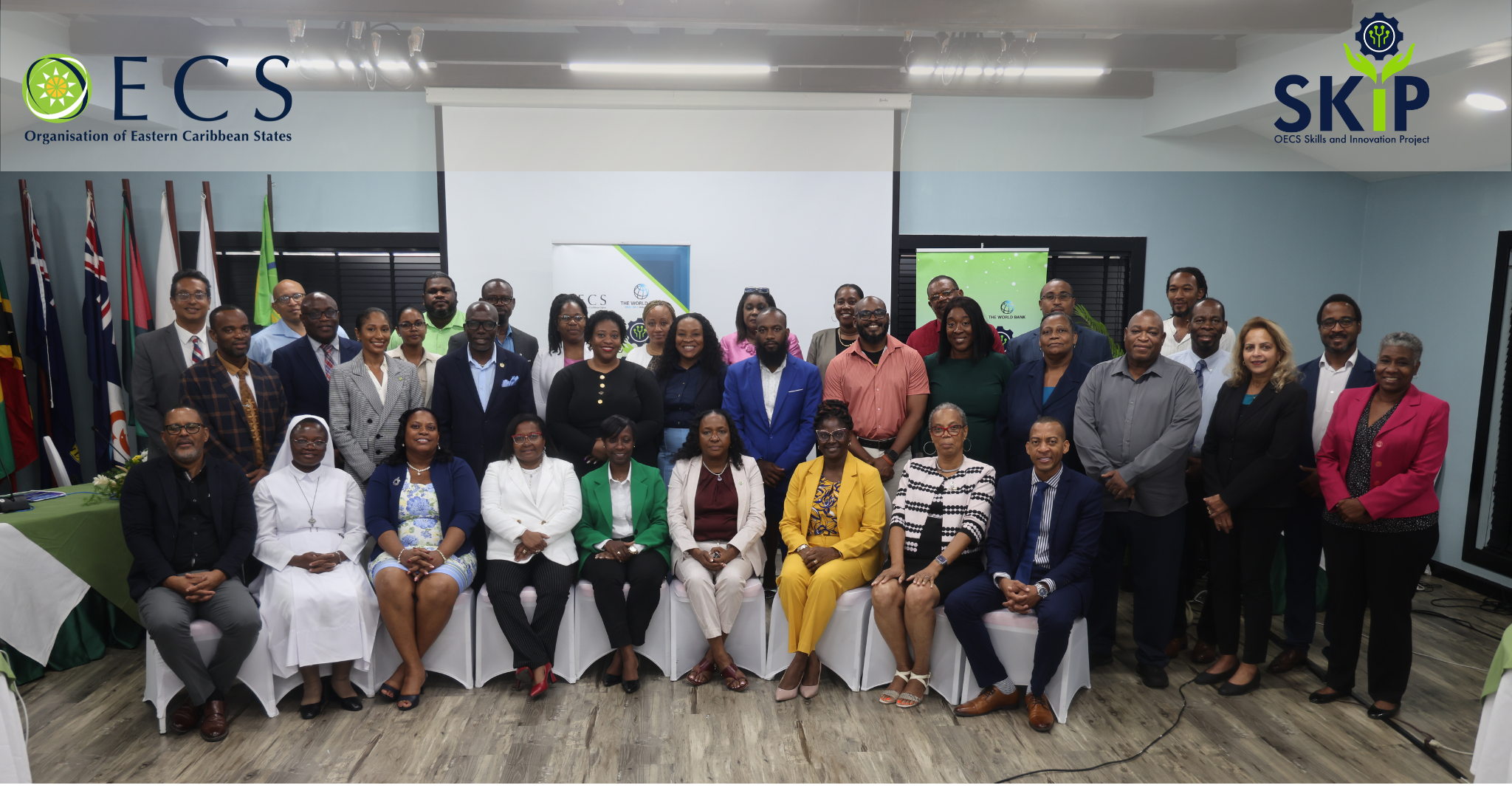
.png "Delegates at the OECS' 7th Higher Education Meeting and Innovation Workshop")
OECS 7th Higher Education Meeting and Innovation Workshop Advances Regional Higher Education Transformation for the 21st Century
OECS MEDIA RELEASE
The Organisation of Eastern Caribbean States (OECS) Commission has taken another significant step toward a more connected, innovative, and future-ready higher education system in the region. The milestone follows the successful conclusion of the 7th Higher Education Meeting and Innovation Workshop.
Convened through the OECS Commission's Education Development Management Unit (EDMU) and powered by the World Bank-funded OECS Skills and Innovation Project (SKIP), the three-day regional meeting brought together education leaders, government officials, tertiary institutions, private sector representatives, development partners and technical experts to shape the future of post-secondary education across the Eastern Caribbean. It forms part of the OECS Commission's broader commitment to strengthening equitable, inclusive and innovation-driven education systems that better prepare citizens with the knowledge and skills needed for a rapidly changing regional and global economy.
Throughout the three-day programme, participants moved beyond discussion to jointly design the governance, policy and operational frameworks that will underpin the next generation of regional digital education infrastructure. These efforts directly support the implementation of the OECS Education Sector Strategy (OESS) while advancing regional collaboration, digital transformation and institutional integration.
The OECS 7th Higher Education Meeting and Innovation Workshop also showcased the continued delivery of the OECS Skills and Innovation Project (SKIP), which supports the modernisation of post-secondary education through investments that strengthen institutional capacity, improve regional collaboration, and expand access to digital learning opportunities.
Reflecting on the significance of the work being advanced through the meeting, Dr Didacus Jules, Director General of the OECS, highlighted the role of the OECS Skills and Innovation Project (SKIP) in translating the vision for a more integrated regional higher education system into tangible solutions. He stated:
“This, colleagues, is not a speech about distant aspiration. The work has begun, and it has begun well. With the World Bank’s formal no-objection to our Revisioning Framework, the OECS Skills and Innovation Project (SKIP) has built three innovation platforms in-house. The first of their kind anywhere in the Caribbean, and replicated, to our knowledge, nowhere else. These platforms are articulation made operational, the ridgeline, laid in steel and in code.”
Building on this vision, Mrs Sisera Simon, Head, Human and Social Division, OECS Commission, underscored the role of the OECS Skills and Innovation Project (SKIP) in strengthening post-secondary education and preparing the region’s people for the opportunities and demands of the 21st century. She stated:
“SKIP represents one of the most significant regional investments in post-secondary education collaboration undertaken within the OECS. The project seeks to strengthen the quality and relevance of post-secondary education, enhance technical and transversal skills, promote innovation, and support stronger linkages between education and employment. Our collective responsibility is to ensure that higher education unlocks the talent, creativity and potential for our people for the benefit of every learner, every institution, every Member State, and the region as a whole.”
Over the three days, delegates reviewed progress under the OECS Education Sector Strategy, validated preliminary findings from a regional higher education gap analysis, and ratified the region's first Regional Data Governance Policy. They also collaboratively developed the governance and intellectual property frameworks required to support the responsible operation of the new regional platforms.
One of the meeting’s major milestones was advancing work on three transformational regional digital platforms currently being developed by the OECS SKIP, aided by expertise from the OECS Software Development Team. Delegates at the meeting received confirmation that the three platforms are being developed internally by the OECS Commission and the OECS Software Development Team. These three digital platforms are the OECS Knowledge, Technology and Innovation Platform (KTIP), the Virtual Campus, and a shared regional Education Management Information System (EMIS). Together, these platforms will strengthen collaboration among tertiary institutions, improve evidence-based decision-making, support innovation and entrepreneurship, and create greater opportunities for learners throughout the OECS. The platforms will be made available to the region's higher education institutions as regional digital public goods, reflecting the OECS commitment to building sustainable regional digital capacity.
The OECS SKIP Project Implementation Consultancy Team (PICT) also presented preliminary findings from its OECS SKIP-supported assessment of the regional post-secondary education sector, highlighting emerging opportunities and gaps across areas including equity and inclusion, programme relevance, quality assurance, financing, governance, skills development and collaboration with industry. The assessment will help inform the development of a comprehensive regional approach to strengthening post-secondary education and collaboration across the OECS. As this work continues, the PICT will engage education institutions, higher education students, employers, private sector organisations and other key stakeholders through interviews, focus groups, surveys and other consultations. The OECS SKIP encourages stakeholders to participate and share their perspectives with the PICT to help ensure the final assessment and recommendations are informed by evidence and reflect the needs and realities of the Eastern Caribbean.
The OECS 7th Higher Education Meeting and Innovation Workshop also advanced the objectives of the OECS Skills and Innovation Project (SKIP) by strengthening regional collaboration among tertiary institutions, promoting harmonised data standards through an OECS Data Policy, encouraging the responsible use of artificial intelligence, shaping shared governance frameworks for regional digital platforms, and deepening partnerships to ensure graduates are equipped with the skills needed for an evolving 21st-century labour market.
Building on these outcomes, the OECS Commission, through the World Bank-funded OECS Skills and Innovation Project (SKIP), will now advance the next phase of implementation by translating the frameworks, recommendations and regional consensus achieved during the meeting into policies, systems and institutional arrangements needed to support the successful rollout of the OECS SKIP Knowledge, Technology and Innovation Platform (KTIP), the OECS Virtual Campus, and the Regional Education Management Information System (EMIS). Together, these efforts will strengthen regional collaboration, accelerate digital transformation and create a more connected, future-ready higher education ecosystem across the OECS.


.JPG)

 Delegates at the OECS' 7th Higher Education Meeting and Innovation Wokshop.
 Delegates at the OECS' 7th Higher Education Meeting and Innovation Wokshop.
 The OECS' 7th Higher Education Meeting and Innovation Wokshop.
 The OECS' 7th Higher Education Meeting and Innovation Wokshop.

 The OECS' 7th Higher Education Meeting and Innovation Wokshop.
 The OECS' 7th Higher Education Meeting and Innovation Wokshop.


Malika Thompson-Cenac
OECS Communications Unit