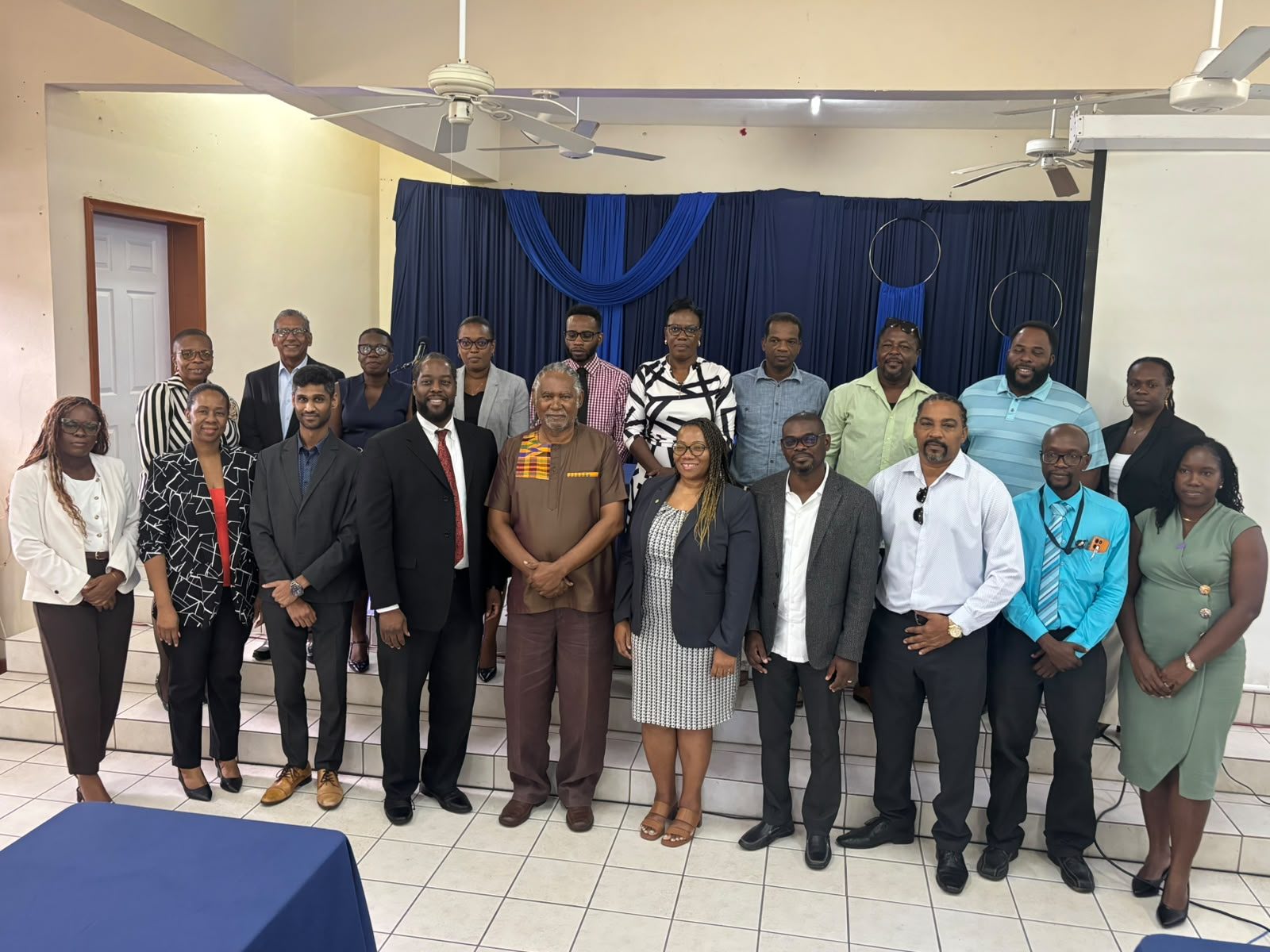
Montserrat Accelerates Digital Transformation and AI Readiness Following OECS and ECLAC Workshop
OECS Press Release
Montserrat has taken a significant step towards modernising its public sector following a three-day capacity-building workshop held from 19–21 October 2026. Organised by the Government of Montserrat in collaboration with the Organisation of Eastern Caribbean States (OECS) Commission and the United Nations Economic Commission for Latin America and the Caribbean (ECLAC), the initiative convened ministers, senior public servants, and regional experts to advance the island's digital transformation, data protection, and Artificial Intelligence (AI) agendas.
The Honourable Reuben Meade, Premier of Montserrat, emphasised the urgency of the initiative during his opening remarks:
"Digital transformation has been an ongoing process for a while, but today, the necessary efforts to transform paper-based systems into digital systems that advance the government e-services agenda is an important priority."

Premier Honourable Reuben Meade challenged participants to take decisive action to realise this vision. Highlighting the strategic importance of the regional initiative, Dr Clarence Henry, Senior Technical Officer in the Regional Integration Unit of the Economic Affairs and Regional Integration Division at the OECS Commission, noted
“Digital transformation is a critical element to support efforts at repositioning the economies, strengthening resilience and securing long-term competitiveness in a world where traditional advantages are eroding and new digital capabilities are determining economic success.”
The economic union calls for the operationalisation of a single economic and financial space to advance growth and development across participating member states. The advancement of digital transformation plays a critical role in achieving this objective. Equally, ensuring that key national stakeholders are provided with the tools to effectively implement digital transformation initiatives is important in securing this objective. Throughout the three-day programme, participants examined key aspects of data governance, evaluating the alignment of regional data protection frameworks with international benchmarks such as the EU and UK General Data Protection Regulation (GDPR).
The workshop also addressed draft AI legislative frameworks for Montserrat and introduced the ECLAC methodology for formulating National Digital and AI Agendas. This work further supports the Commission’s agenda to implement AI frameworks in various sectors such as in education and health that improves efficiency and service delivery for citizens of member states.
To bridge policy and implementation, senior public servants evaluated a selected government service to identify opportunities for digitisation, efficiency, and cost reduction. The sessions culminated in the development of a 90-day action plan designed to translate strategic discussions into practical outcomes. The workshop also highlighted broader regional integration tools, including findings from the OECS Digital Economy Harmonisation Report and presentations on ECLAC’s Digital Development Lab (DLab) and data embassy initiatives.
By fostering collaboration between the Government of Montserrat, the OECS Commission, ECLAC, and the University of the West Indies (UWI) AI Innovation Centre, the initiative ensures Montserrat’s national digital priorities remain closely aligned with wider Eastern Caribbean development goals. Moving forward, stakeholders will focus on maintaining momentum to finalise policy frameworks and build sustained institutional capacity.
Additionally, the OECS Commission’s Human and Social Division (HSD), through its Education Development Management Unit (EDMU), is turning digital transformation and AI readiness into tangible outputs. Guided by the belief that strong policy must translate into real human impact, the Division is building out the OECS Digital Learning Ecosystem (ODLE), a suite of platforms that connects learners from primary through post-secondary education, supports teachers in the classroom, and gives ministries and education officials the data they need for reporting, planning, and regional monitoring.
The Commission, through its Program for Educational Advancement and Relevant Learning (PEARL) has digitised the OECS Harmonised Primary Curriculum and introduced the OECS Learning Hub thereby equipping educators with AI-enabled content tools, offline teaching assistants for low-connectivity classrooms, and streamlined Monitoring, Evaluation, Research, and Learning (MERL) systems.
Simultaneously, the OECS Skills and Innovation Project (SKIP) is bridging the post-secondary space through a regional Virtual Campus, the Knowledge, Technology and Innovation Platform (KTIP), modernised Education Management Information Systems (EMIS), and an applied Data Governance Framework. While being designed as regional digital public infrastructure, across these platforms, personally identifiable information is available only to those whose role requires it and is anonymised in regional reporting, while end users remain in charge of how AI is used, bringing their own professional expertise to what it produces. In this way, the Commission is putting into practice the principles of data protection and responsible AI discussed in Montserrat, in service to OECS citizens.


Marvin St. Louis
OECS Communications Unit