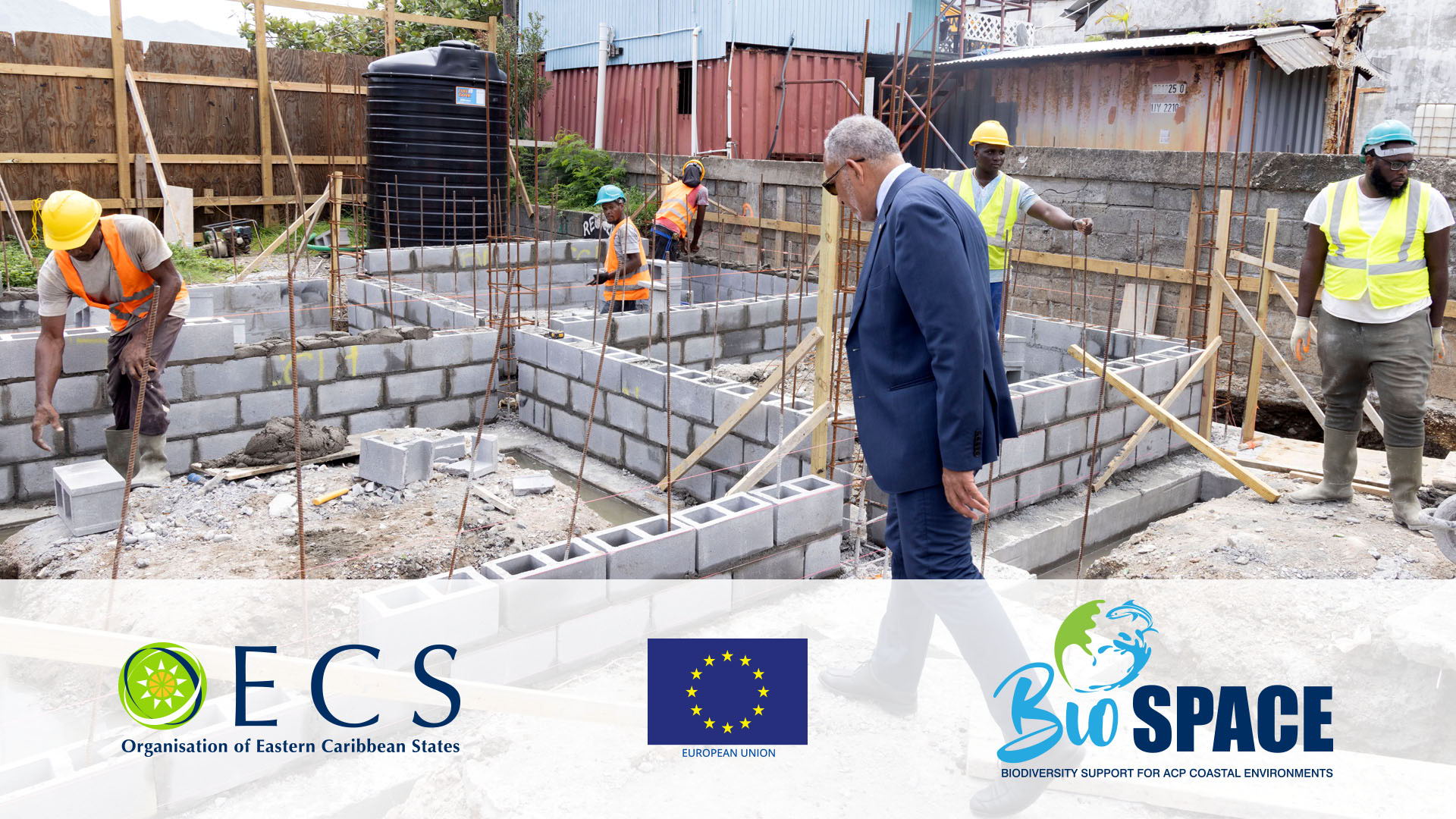
Major EU-Funded BioSPACE Investment to Transform Bequia Fish Market
OECS Media Release
Fishers and residents of Bequia are set to benefit from a modern, safer and more resilient fish market through the rehabilitation of the Port Elizabeth Fish Market under the European Union-funded Biodiversity Support Programme for ACP Coastal Environments (BioSPACE), implemented by the Organisation of Eastern Caribbean States (OECS) Commission.
The approximately EC$3.2 million investment will significantly improve the facility's capacity to support fish handling, processing, storage and marketing, while strengthening livelihoods and the wider fisheries value chain in Bequia.
A ceremony on August 25, 2026, marking the commencement of the rehabilitation works brought together representatives of the Government of Saint Vincent and the Grenadines, the OECS Commission, the European Union, the fishing community, contractors, technical personnel and residents of Bequia.
Speaking at the ceremony, Prime Minister of Saint Vincent and the Grenadines and Parliamentary Representative for the Northern Grenadines, Dr. Godwin Friday, underscored the investment's importance to the country's blue economy.
“This is built not just for something to look good and to show and to function for a few years. We have very limited resources, so when we build now, we have to make sure we build to last,” Prime Minister Friday said.
He noted that the upgraded facility will provide improved cold storage and fish handling while recognising fisherfolk as valuable contributors to the economy, food security and the development of the blue economy.


Minister for Fisheries, Marine and Land Conservation and Climate Resilience, Hon. Conrad Huggins, described the project as part of a renewed vision for the fisheries sector.
“Today, it is not just the launch of this project...but it is about a renewed vision for the sector,” Minister Huggins said, highlighting the Government's increased focus on fisheries as an important economic pillar.
Speaking on behalf of the OECS Director General, Dr. Didacus Jules, Mrs. Natasha Deterville-Moise, Technical Specialist- Agriculture and Officer-in-Charge, Economic Development Unit, emphasised that the investment extends beyond the physical infrastructure.
“This is therefore much more than the rehabilitation of a physical facility. It is an investment in the people whose livelihoods depend on the sea, in the systems that support those livelihoods, and in the resilience of communities whose social and economic life is closely connected to its marine resources,” she said.
Chief Fisheries Officer, Mrs. Jennifer Cruickshank Howard, also highlighted the importance of fisheries infrastructure to livelihoods, income and food and nutrition security, noting that appropriate facilities are critical to ensuring fish can be safely handled, stored and distributed.
The rehabilitated market will feature additional processing and market space, improved cold storage, a marine-life weighing zone, chiller and freezer rooms, ice-making equipment, office and equipment-storage areas, and improved administrative facilities. These upgrades are expected to improve fish quality and handling, reduce post-harvest losses and provide a safer, and more efficient working environment for fishers and vendors.
Mr. Quentin Peignaux, a Programme Director with the European Union's delegation in Barbados, reaffirmed the EU's commitment to supporting small-scale fisheries and community livelihoods, noting that the BioSPACE Project seeks to demonstrate that biodiversity conservation and sustainable livelihoods can advance together.
The rehabilitation of the Bequia Fish Market forms part of the wider BioSPACE Project, through which the European Union and OECS Commission are supporting biodiversity conservation, sustainable use of coastal and marine resources, and resilient livelihoods across the Eastern Caribbean.
The investment is expected to deliver lasting benefits for Bequia's fishers, vendors, consumers, and the wider community while contributing to the development of a more resilient and sustainable blue economy in Saint Vincent and the Grenadines.

Danny Moonie
OECS Communications Unit