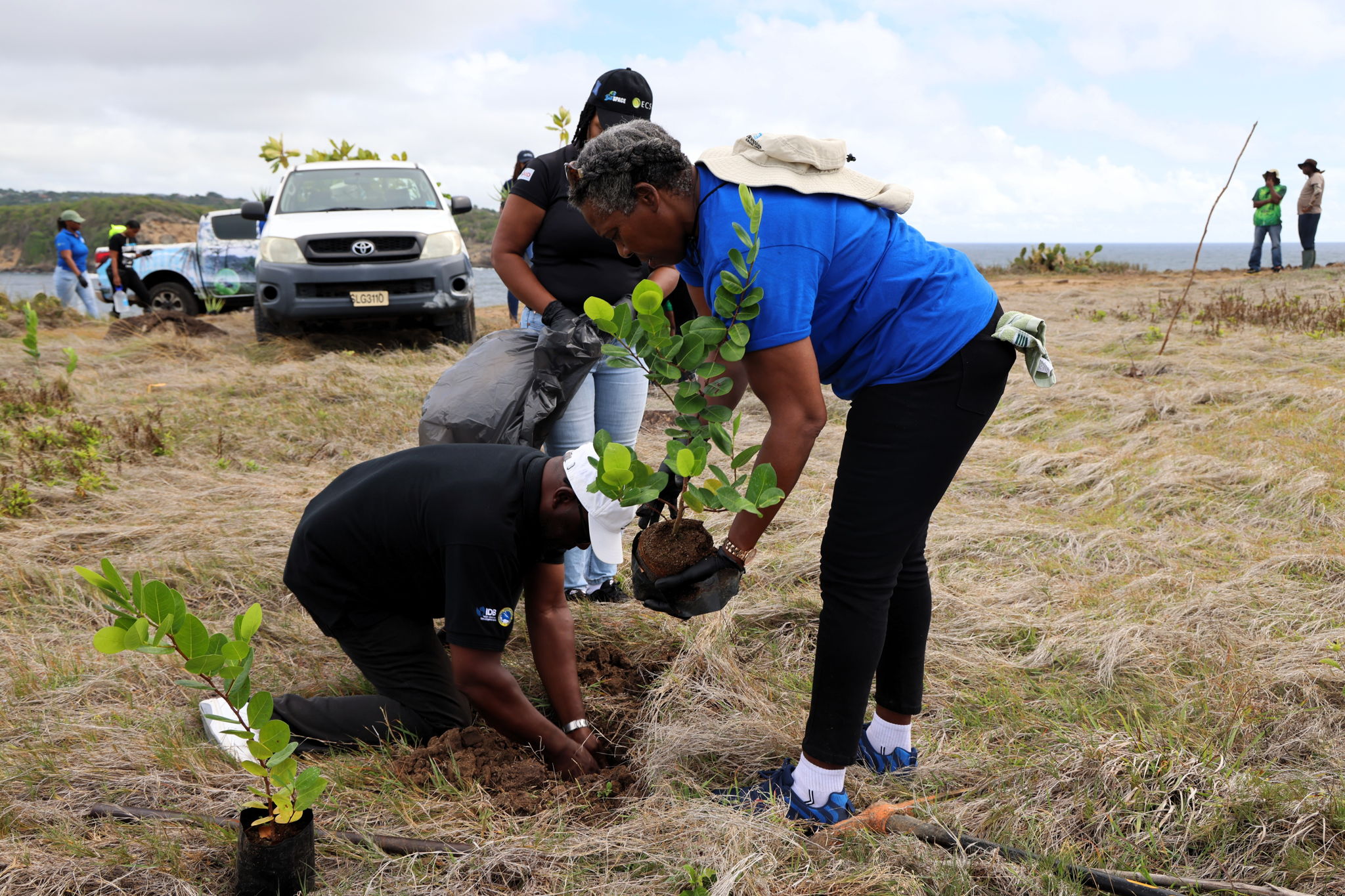
Fire-Prone Land at Point Vierge, Micoud, Benefited from Replanting Activity for OECS 45th Anniversary
OECS Media Release
Over 25 OECS Commission staff members and colleagues from the Saint Lucia Ministry of Agriculture, Fisheries, Food Security and Sustainable Development undertook a tree-planting exercise at Point Vierge, Micoud, on 17 June 2026, restoring an area repeatedly scarred by wildfires. The Commission staff wanted to celebrate the 45th OECS Anniversary by signifying life and growth.
Held under the 45th OECS Anniversary theme, “One Vision, One Voice: Navigating Challenges, Shaping Our Future,” the exercise transformed four and a half decades of regional integration into roots in the ground. Fittingly, the activity also coincided with the United Nations World Day to Combat Desertification and Drought, anchoring the OECS celebration in one of the most urgent challenges of our time. It was also the staff's example of participating in the flagship 45 for 45 Changemaker Initiative launched for the anniversary.
Point Vierge stands exposed to the elements, battered by harsh wind and sun, and is prone to recurring wildfires that strip the land bare year after year. To break that cycle, the plant species deliberately selected are hardy and fire-resilient: fat poke, aloes, and sea grapes, planted alongside almond and white cedar to provide shade and food. Every tree placed in that soil is intended as a frontline defence against the advance of degraded, lifeless land.
The exercise drew support from various projects across the Organisation, including BioSPACE, the RIGHT Programme, the UBEC Project and GEOBUILD. Partnership with officials of the Southeast Coast Project (SECP), whose team assisted with the planting, and the Quilesse Forest Range helped with the flawless delivery of the activity through their expertise, guidance, and hands-on support.
The initiative reflects OECS Strategic Priority #3, to value the environment, and confronts head-on the mounting implications of climate change and global warming for the region's ecosystems, food security, and livelihoods.
Mr. Marvin Edward, Forest Officer with the Division of Forest and Land Resources Development, who took part in the exercise, captured the spirit of the day:
“One of the simplest yet most powerful actions we can take is to plant a tree. Trees absorb carbon dioxide, improve air quality, prevent soil erosion, conserve water, provide habitat for wildlife, and help restore degraded land. Together, through responsible land management and tree planting, we can help combat desertification, reduce the effects of climate change, and build a more sustainable future for all.”
Reflecting on the meaning of the day, Natasha Deterville-Moise, Officer in Charge of the Economic Development Unit at the OECS Commission, added:
“Each tree planted today is a symbol of growth, resilience, unity and hope, the very values that have guided the OECS throughout its 45-year journey. May these trees serve as a lasting reminder that the decisions and actions we take now will shape the environmental future of the Eastern Caribbean.”
As the Organisation looks back on 45 years of regional integration, the trees rising at Point Vierge stand as a promise to the future. Through continued collaboration among governments, organisations, communities, and individuals, the OECS reaffirms its resolve to build a greener, more resilient, and more sustainable region.
About the OECS
The Organisation of Eastern Caribbean States (OECS) is an international intergovernmental organisation established by the Treaty of Basseterre in 1981. The OECS promotes regional integration, sustainable development, and economic and social progress across its Member States.
About BioSPACE
The Biodiversity Support Programme in ACP SIDS and Coastal Environments (BioSPACE) is a regional initiative designed to support Caribbean Small Island Developing States (SIDS) in the sustainable management of marine and coastal resources. Managed by the OECS, with funding from the European Union (EU), the project empowers OECS Member States to strengthen regional capacity, build climate resilience, and effectively protect marine and terrestrial biodiversity through targeted technical assistance and policy development.


