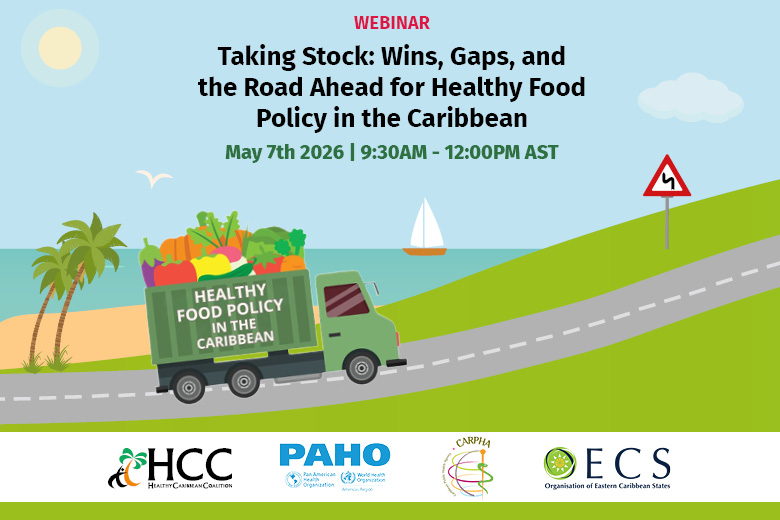
Caribbean Leaders and Public Health Experts Call for Urgent Action on Healthy Food Policy to Combat the Region's NCD Crisis
Joint Media Release
As the Caribbean continues to face one of the highest burdens of noncommunicable diseases (NCDs) globally, regional leaders, Ministries of Health, civil society advocates, educators, researchers, and international public health experts are calling for accelerated implementation of evidence-based food policies to protect current and future generations.
This urgent message emerged from the regional webinar, “Taking Stock: Wins, Gaps, and the Road Ahead for Healthy Food Policy in the Caribbean,” convened by the Healthy Caribbean Coalition (HCC), Pan American Health Organization (PAHO), Caribbean Public Health Agency (CARPHA), and the Organisation of Eastern Caribbean States (OECS) Commission. The event brought together a broad coalition of stakeholders to examine progress, confront implementation challenges, and identify practical pathways toward healthier Caribbean food environments.
The discussions took place against the backdrop of an escalating public health emergency. NCDs, including heart disease, diabetes, cancers, obesity, and chronic respiratory diseases, remain the leading causes of death and disability across the Caribbean. Participants stressed that the region’s ongoing nutrition transition, marked by the widespread availability and affordability of ultra-processed foods and beverages alongside the high cost of healthier diets, continues to fuel rising rates of obesity and diet-related diseases.
Speakers emphasised that the scientific evidence for effective interventions is already well established. Drawing from the World Health Organization’s “Best Buys” and the Caribbean Public Health Agency's 6-Point Policy Package, participants highlighted proven measures including front-of-package warning nutrition labelling, elimination of industrially produced trans fats, sugar-sweetened beverage taxation, restrictions on unhealthy food marketing to children, healthier public food procurement policies, breastfeeding protection measures, and incentives to improve access to fruits and vegetables.
Despite this clear roadmap, however, the Caribbean is not meeting its NCD targets. Dr Heather Armstrong, Head of the Chronic Disease and Injuries Department, CARPHA, highlighted that “policy implementation and enforcement continued to be slow and uneven across the region”. Participants noted that only Antigua and Barbuda, Barbados, and Grenada were on track to meet the 2025 NCD targets among Member States of the Americas, while several others could still make substantial progress with accelerated action.
Opening the discussion, Dr Christopher Tufton, Minister of Health and Wellness of Jamaica, underscored the urgent need to address excessive consumption of sugar-sweetened beverages as part of broader national efforts to reduce the burden of NCDs.
“Over 75% of the adult population consumes at least one sweetened beverage every day,” he noted, warning that sugary drinks contribute significant calories with little or no nutritional value.
He emphasised that the impact falls disproportionately on vulnerable populations and reaffirmed Jamaica’s commitment to implementing a Special Consumption Tax on sweetened beverages while advancing broader nutrition reforms, including healthier food standards within hospitals and continued work with national partners such as the Heart Foundation of Jamaica.
Dr Miriam Alvarado, Research Fellow, reinforced the power of fiscal policies such as the sweetened beverage taxes in Jamaica and Barbados, to reduce obesity and NCDs, especially in the Caribbean, where sugar-sweetened beverage consumption rates exceed the global average.
Representing the Pan American Health Organization Caribbean Subregional Program Coordination, Dr Gloria Giraldo highlighted the complex realities Caribbean countries face when implementing food policy, including food insecurity, trade pressures, economic vulnerability, and climate-related challenges. At the same time, she stressed that healthy food environments do not emerge by chance.
“Healthy environments are shaped by public policy, political leadership, and collective action,” she emphasised, noting that the Caribbean’s NCD epidemic is deeply intertwined with broader social, economic, and commercial forces influencing policy decisions across the region.
Dr Giraldo identified front-of-package warning labelling, protection from inappropriate marketing of breast milk substitutes, and the elimination of industrially produced trans fats as priority areas requiring urgent action from Caribbean policymakers.
Throughout the webinar, participants repeatedly addressed the growing influence of the commercial determinants of health, the systems, practices, and market forces that shape unhealthy consumption patterns and may delay or weaken public health policies.
Speakers discussed the importance of safeguarding policy-making processes from undue influence and conflicts of interest while strengthening transparency, accountability, and evidence-based decision-making. Civil society leaders highlighted the critical role of advocacy organisations, youth, and communities in ensuring that public health remains at the centre of policy discussions.
Dr Mauricio Toro, legislator and public health advocate from Colombia, reflected on lessons learned from advancing food policy legislation outside the Caribbean. He stressed that scientific evidence alone is insufficient to generate political action.
“Scientific evidence is essential, but it does not stand on its own to galvanise political will,” he stated, emphasising the importance of civil society mobilisation, strategic communication, and simple, compelling public narratives in advancing health-promoting legislation.
The webinar also highlighted promising examples of policy innovation and implementation emerging across the region.
Representatives from Barbados, Jamaica, Trinidad and Tobago, and The Bahamas shared experiences related to school nutrition policies, healthier food environments, and legislative reforms. Participants described how some manufacturers are reformulating products to comply with new nutrition standards, while schools, vendors, educators, and communities are collaborating through initiatives such as healthier procurement practices, advocacy campaigns, greenhouse farming, and nutrition education activities.
A particularly striking discussion focused on school feeding and child nutrition. According to data shared by Mrs Sisera Simon, Head of the Human and Social Division, OECS Commission, a regional survey involving approximately 67,000 children revealed alarming levels of food insecurity affecting students across multiple age groups. Speakers stressed that ensuring access to healthy, nutritious meals in schools is not only an educational issue but also a critical investment in health, equity, and long-term development.
Participants also emphasised the importance of multisectoral collaboration, noting that food policy extends far beyond the health sector. Effective responses require coordinated action across education, agriculture, trade, finance, social protection, urban planning, and community development.
The webinar concluded with a strong call for governments, regional institutions, civil society, academia, and international partners to move from commitment to implementation with greater urgency and coordination.
Key recommendations included strengthening youth engagement, increasing the participation of persons living with NCDs in policy discussions, utilising regional technical guidance such as CARPHA’s 6-Point Policy Package, improving policy surveillance and accountability mechanisms, and investing in implementation research to better understand what works in Caribbean contexts.
As the Caribbean approaches the twentieth anniversary of the landmark 2007 Port-of-Spain Declaration on NCDs, participants stressed that the region has both the evidence and the policy tools needed to significantly reduce preventable illness and premature deaths. What is now required, they noted, is sustained political courage, policy coherence, and collective societal action.
Building on the momentum generated during the webinar, a regional workshop on the elimination of industrially produced trans fats and salt reduction targets will be convened from May 27 – 29, 2026, at the Pan American Health Organization Caribbean Subregional Program Coordination in Barbados, further advancing regional collaboration toward healthier food systems and stronger protection of Caribbean populations from diet-related NCDs.

.jpg)


Sheena Warner Edwards
Malika Thompson-Cenac
OECS Communications Unit