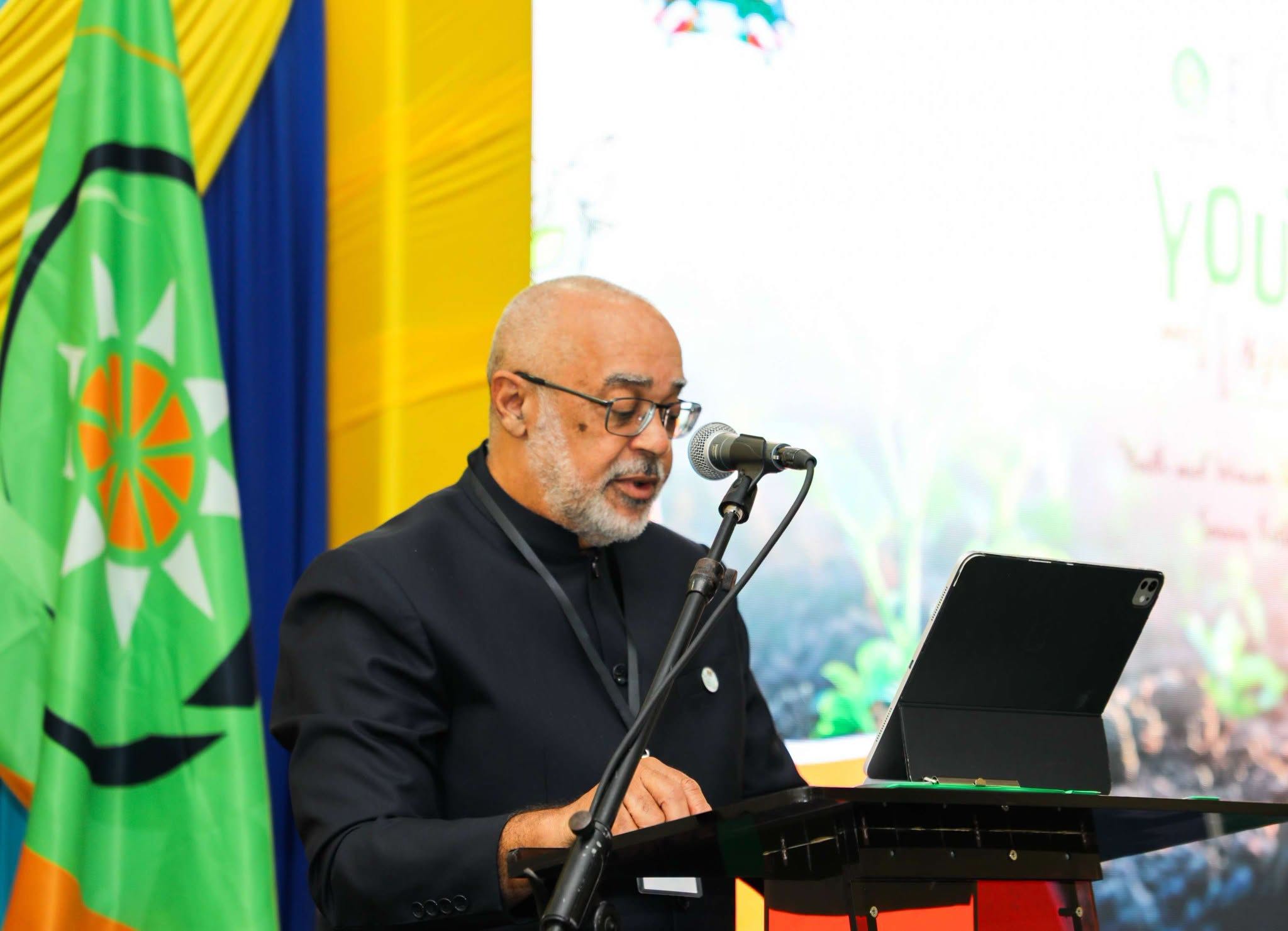
Address by Dr. Didacus Jules at the 2026 Youth and Women in Agriculture Symposium
OECS Director General Official Remarks
1. Opening - where we stand
It is fitting that we meet in Grenada.
This is the soil that produced T. A. Marryshow, who insisted that the West Indies must be West Indian - that we would not be governed by the imagination of others. Almost a century later, we gather in his birthplace to say something that is not so different: that what we eat, who grows it, and who profits from it must also be West Indian.
I want to begin by naming what I see in this room. Over one hundred young people, women and persons with disability from Grenada alone registered their interest in this symposium. Add to that the delegations from across our Member States. This is an extraordinary signal. When more than a hundred people volunteer to spend three days talking about agriculture, the question of whether our young people are interested in farming has been answered and the answer is that they have been waiting to be asked.
2. The urgency - why now
What is the driving urgency of this initiative?
We are living through a period of accelerating entropy. The global order that our small states learned to navigate is coming apart faster than it is being rebuilt. Trade rules are being rewritten unilaterally. Tariffs are being deployed as instruments of coercion. Development assistance is being cut, redirected, or made conditional on things that have nothing to do with development. Shipping costs and insurance premiums for small island states climb with every storm season. And the multilateral institutions we relied upon to arbitrate fairness are themselves under strain.
In physics, entropy is the tendency of every system to run down toward disorder unless energy is deliberately put into it. That is a precise description of our moment. And it means that nothing about our food security will hold itself together by inertia. It must be actively built.
Consider our exposure. Our region imports the overwhelming majority of what it consumes, at a cost of US$658 Million every year - money that leaves this region and never returns. Every dollar of that import bill is a dollar of vulnerability. It is a dollar we cannot spend on our schools. It is a dollar that gives someone else leverage over what our children eat.
And Grenada knows better than most what a single event can do. Ivan took the nutmeg. Beryl took Carriacou and Petite Martinique. You have twice had to rebuild a sector from the ground, and you know the arithmetic of it - that a nutmeg tree takes the better part of a decade to bear, which means that replanting is an act of faith in a generation you may not live to see harvest.
That is the honest frame for this symposium. We are not here because agriculture is a nice idea for young people. We are here because in a fracturing world, the capacity to feed ourselves is the most concrete expression of sovereignty available to a small state. And also because the average age of our farmers tells us that this capacity is one generation away from being lost.
3. Commendation - the commitment of governments
Against that backdrop, I want to commend our governments, and I want to be specific about why.
In October 2024, at a Special Meeting of the Council of Ministers: Agriculture in Saint Vincent and the Grenadines, Ministers took a decision that seems administrative and is in fact profound: they folded women into the youth in agriculture programme, on the reasoning that the barriers are substantially the same. Land. Finance. Recognition. A seat where decisions are made. That decision is the reason this is a Youth and Women symposium, and it deserves to be recorded. Then – of their own accord – the organisations of differently abled persons got involved and have unquestionably established their capacity and their right to be active in this venture.
In Costa Rica in May 2025, something rarer happened. Ministers of Agriculture sat down and were presented to - by young farmers. Not consulted about. Presented to. Our young people delivered a roadmap to their own Ministers, and their Ministers received it. I have been in regional governance a long time. That inversion of the usual order is not common, and the Ministers who sat in that room should be commended for allowing it.
To the Government and people of Grenada: thank you for hosting and thank you for the seriousness of your preparation. And to our partners at IICA, whose collaboration made the Costa Rica engagement possible, and to the European Union-funded 11th EDF RIGHT Programme who financed much of this work - our appreciation is genuine and on the record.
4. Accountability - what was promised, what has moved
But commendation without accountability is flattery, and you did not come here for flattery.
So let me report to you on your own roadmap.
You asked for exposure to how agriculture is done elsewhere. Since Costa Rica, we have run the climate-smart agriculture and sustainable entrepreneurship workshop in Saint Lucia in July 2025 - AI and data in agriculture, drones, small-scale mechanisation, soil and water management, business planning and financial literacy. And in October 2025 we took a delegation to Spain under the EU-CAN partnership to study cooperative and social-economy models in agri-food and fisheries.
Now hear what came out of that - because this is the part I want every Minister in this room to register.
A young farmer from Dominica Mr. Kevon Vidal exported produce to fellow young farmers in Montserrat. Not through an agency. Through a relationship formed on a study tour.
And a young farmer Ms. Melinda Robinson from this region was invited back to Costa Rica to work alongside another farming group.
Those two facts are small but they are significant indicators of possibility. They tell us that when you put our young people in a room together, they do not merely network - they trade and that shows commitment and seriousness. They built intra-regional commerce out of a study tour. That is the OECS Economic Union functioning at the level where it actually matters: between two young people who decided to do business with each other.
What has not yet moved is equally important, and I will not pretend otherwise. Land access remains the hardest of your demands. The interest rate question at our financial institutions remains largely unresolved. The one-stop information portal you asked for, grants, land, markets, technical guidance in one place - is not yet built. These remain a work in progress that we must accelerate. The request for agricultural scholarships we expect will soon be addressed as we will be meeting with IICA next month to finalize the Agribusiness Diploma Programme for the youth
5. The charge - what must come out of Grenada
So let this symposium produce more than goodwill. I ask for four things.
First, that the OECS Agriculture Forum for Youth stop being a proposal and become an institution. Constitute it here, this week, with names, a structure, and a mandate. The Commission and IICA will support it. But it must belong to you, or it will not survive us.
Second, that the information portal be delivered, co-managed by the OECS Commission and IICA, with a target date agreed before you leave Grenada.
Third, that our Ministers return home with the land question. Access to Crown lands, on transparent terms, at rates a young farmer can pay, under a tenure arrangement a bank will recognise as collateral. Every other intervention we make is diminished if a young person has nowhere to stand.
Fourth, that inclusion be structural and not ceremonial. Persons with disability registered for this symposium in meaningful numbers. Design your Forum, your training and your financing instruments so that they are not an afterthought.
6. Close
Let me repeat some critical contextual considerations.
Entropy is only overcome by the deliberate application of energy. A sector does not renew itself; it is renewed by people who choose it. A region does not become food-secure by declaration; it becomes food-secure one farm, one cooperative, one young woman, one differently abled entrepreneur with a business plan at a time.
The generation that planted nutmeg after Ivan did so knowing they would wait years for the first harvest. They planted anyway, because the alternative was to hand their children an empty hillside.
You are that generation now. The soil is the same. The urgency is greater. And the difference - the real difference - is that this time you are not being planted for. You are doing the planting, and you are in the room where the decisions are made.
Sow well. We will be here for the reaping.
I thank you.
